International Research Training Group:
Competition for land - Tackling the climate and biodiversity crises through the food, energy and materials nexus (C4LaNd)
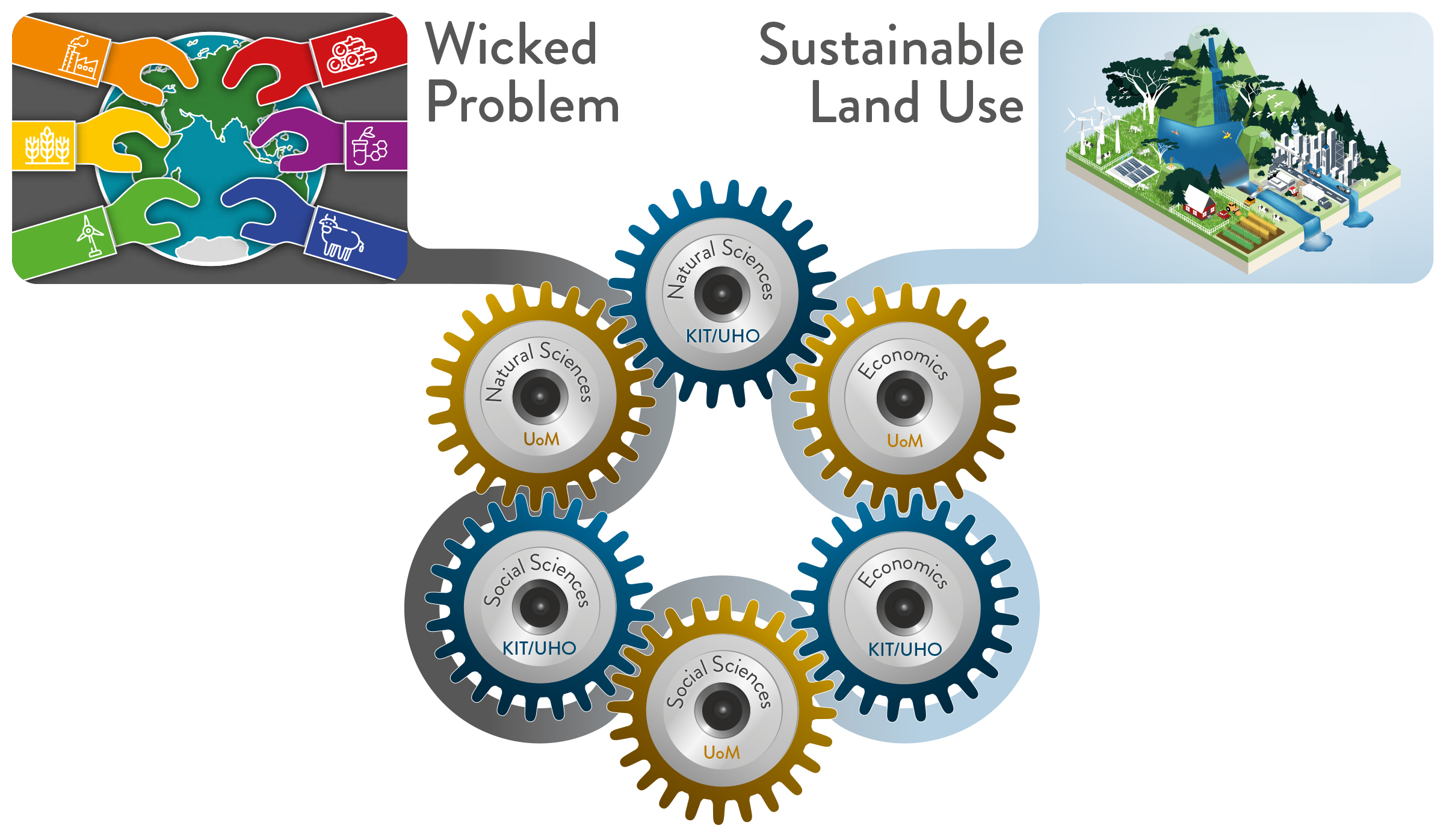
C4LaNd is an International Research Training Group that addresses a classical “wicked problem”: how to meet the ever-increasing and often conflicting demands on land for food,
renewable energy, and materials without compromising biodiversity conservation and climate action.
The joint research program offers a total of 48 doctoral positions at KIT, Hohenheim University and the University of Melbourne
and covers natural sciences, social sciences, and economics to deliver high quality, coordinated research towards land use becoming part of the solution to the climate and biodiversity crises, rather than a major cause.
The first cohort of 12 doctoral students in Germany and 12 in Melbourne will begin in autumn 2026.
Educational concept
The educational concept of C4LaNd is designed to educate the next-generation of researchers with a ‘nexus’ perspective’. It is designed to provide the necessary advanced methodological skills to address the scientific, societal, financial, and regulatory challenges arising from food-energy-materials demand and competition in the land-system in view of climate change and biodiversity loss. The doctoral students will receive both a doctoral degree from Australia (University of Melbourne) and from Germany (either KIT or University of Hohenheim). The doctoral students will be supervised by one supervisor from Germany and Australia. A thesis advisory group of 2-3 scientists will be established for each doctoral student, bringing in further researchers from the different departments associated with C4LaNd to broaden the required scientific expertise, whenever needed. The first year of the doctoral research will be spent at the home institution. The last year is focused on completing the PhD thesis, which will also be done at the home institution. In between, a one-year research stay abroad in Germany or Melbourne will be used to interact with their counterpart and to benefit from the additional expertise in C4LaNd. C4LaND offers a unique and specifically designed qualification program ‘from Specialists to Nexialists‘, tailored to its research programme. Three types of courses will be offered
- Trainings on key academic skills including good research practice, research data management, and AI assistants in research.
- Workshops on career development, supporting successful careers inside or outside academia.
- ‘Think Nexy’: a set of activities that spread over the entire doctoral training period including annual retreats and a C4LaNdClass that brings together doctoral researchers and supervisors on a monthly basis.
Research
To understand the many processes that operate across natural, socio-economic and technical systems, and the interactions and feedbacks between them, different disciplines and skills need to establish a close working relationship,
ranging from, for example, land-use change and ecological modelling, (intertemporal) economic optimisation and life cycle assessments to ethics, governance and spatial planning. We aspire to develop an interdisciplinary research and training programme
that will provide the necessary scientific understanding to quantify, based on sound theoretical underpinnings, how land use can contribute to climate change mitigation and biodiversity conservation whilst avoiding detrimental societal impacts, i.e.,
by maintaining supplies of food, energy, materials, and multiple other ecosystem services.
The complexity of the nexus requires multidisciplinary and multi-method knowledge development to gain insight into sustainable solutions. To ensure that within this complexity individual doctoral studies address tractable questions,
and have clearly defined objectives— while maintaining a broad perspective on the overarching environmental challenges—the research programme will be structured around four research clusters:
Cluster C1 (Rethinking Food) will explore how transformative changes in the food system could ‘free-up’ land for other uses and reduce greenhouse-gas emissions through new food production technologies, changing locations of food production (e.g., in urban areas),
improved food distribution technologies, and shifts in consumer behaviour and demands (e.g., diets, attitudes to novel products).
Clusters C2 and C3 (Rethinking urban and rural spaces) will explore innovative uses of space with a focus on multi-functional uses within cityscapes (C2) and rural landscapes (C3).
Cluster C4 (Unlocking restoration) will explore how ecosystem restoration could best be used to achieve multiple benefits for biodiversity conservation and climate change, while avoiding negative societal impacts.
C4 complements the issues explored in C1-C3, since the benefits of restoration depend critically on whether land competition can be reduced sufficiently to make room for restoration.
The research in the Cluster Rethinking Food is predicated on the notion that a combination of novel supply- and demand-side measures in the food system are needed to achieve co-benefits for the environment and society across the nexus. PhD-theses will be guided by the following overarching questions:
- Where and how can novel methods of food production provide social, economic and environmental co-benefits including reducing the land footprint?
- Where and how can changes in food consumption choices free-up land for other uses and what are the barriers to, and enablers of, dietary change?
- Which interventions support the transition of the food system towards a sustainable future also taking account of the potential risks arising from socio-economic and climatic ‘shocks’?
The research in Cluster Rethinking urban spaces is grounded on the idea that a combination of novel integrated transformation measures in the urban “landscape”
towards multi-functional urban land use can have co-benefits for the environment and society across the nexus. PhD theses will be guided by the following overarching questions:
- What socio-economic, political and environmental forces shape competition for urban land uses, and how can they be characterized across different city contexts?
- What are the multi-functional land use configurations for different urban areas that maximize environmental, social and economic benefits while minimizing conflicts?
- How can urban transformation pathways be designed and governed to equitably distribute benefits and burdens across different stakeholders and communities?
In the context of finding solutions that equally address the environmental and societal sustainability dimensions of single- vs. multiple land-uses as a key nexus challenge, the Cluster Rethinking rural spaces focuses on the following research questions:
- What socio-economic, natural, political, or institutional factors influence the development and forms of single- and multi-functional land uses at local, national, and international levels
- What are the effects of multi-functional land uses and how are benefits and resources shared?
- How do land ownership and policies on climate change and nature conservation influence the development and impact of these uses, both now and in future?
Ecosystem restoration is central to halting and reversing biodiversity loss, with climate change co-benefits. In view of the manifold benefits, while acknowledging the risks and trade-offs,
it is critical to find ways to upscale restoration so that both biodiversity and people benefit. The research in Unlocking restoration thus will explore
- Where is space for restoration and which protection and restoration measures lead to climate and biodiversity co-benefits?
- What are the social and economic implications of restoration?
- Which management measures increase the resilience of restored ecosystems in a changing climate?
Open Positions
PostDoc and doctoral positions are now open for applications.
In Australia, all PhD positions are based in Melbourne.
In Germany, there are different home locations: KIT has positions open based in Karlsruhe and at its Campus-Alpin in Garmisch-Partenkirchen.
The University of Hohenheim also has positions available.
Please note that a mandatory research stay at the partner institute
(in Germany if you’re based at the University of Melbourne or the other way around) is foreseen for a period of 12 months.
Application deadline for positions is May 17th.
PostDoc Position in Germany
C4LaNd will also provide two systematic review papers during its five-year funding period, synthesising knowledge gained in C4LaNd as well as the broader literature. This activity is led by a post-doctoral researcher. The position is within the Global Land-Ecosystem Modelling Group at KIT’s 'Campus Alpin' in Garmisch-Partenkirchen, Germany.
Do you have sound knowledge of land ecosystems, climate change and land use change? Do you have very good systematic review and text mining skills?
Are you keen to apply these to address societal and ecological research challenges? If so, we can offer you a post-doctoral position within a multidisciplinary,
international research environment, with partners at the Karlsruhe Institute of Technology, the University of Melbourne and the University of Hohenheim.
Lines of research include:
- Develop the overarching questions of the Nexus review and a structure of the foreseen manuscripts
- Lead the systematic literature review and subsequent synthesis and assessment
- Utilise modern tools for automated text mining and content analysis, including machine learning approaches
- Coordinate with contributing researchers to this effort
- Lead drafting and revision of manuscripts
- Document the workflow
Requirements
- A Ph.D. degree in environmental science, ecology, meteorology, or related areas
- Experience in systematic literature reviews and meta-analyses, including machine learning techniques for content analyses
- Capacity to synthesise and assess information from diverse literature sources
- Organisational skills and experience in leading group-efforts
- Fluency in English
- Delight in engaging within a multi-disciplinary international team
- Willingness to travel
Salary
Salary and benefits will be based on the Collective Agreement for the German Public Service Sector (TV-L). Funding will be initially for a two-year period with the possibility of extension up to five years.
Application deadline, selection and expected start date
Applications should include a letter of motivation, CV, and contact details of two references. Applications are open until May 17. Interviews will be conducted before mid June. We expect the position to start late (ca. November) 2026.
Contact person
For inquiries, please contact almut.arneth∂kit.edu
Open PhD Topics in Cluster 1 (Rethinking Food)
Open PhD Topics in Cluster 2 (Rethinking Urban Spaces)
Open PhD Topics in Cluster 3 (Rethinking Rural Spaces)
Open PhD Topics in Cluster 4 (Unlocking Restoration)
Do you have knowledge of land ecosystems, climate change and land use change? Do you have good quantitative and
coding skills? Are you keen to apply these to address societal and ecological research challenges? If so, we can offer you to earn your Ph.D. degree within a multidisciplinary, international research training group, with partners at the Karlsruhe Institute of Technology,
the University of Melbourne and the University of Hohenheim.
The PhD position 'Modelling Sustainable European Forests in a Future Climate' in C4LaNd is within the Global Land-Ecosystem Modelling Group
at KIT’s 'Campus Alpin' in Garmisch-Partenkirchen, Germany, partnered with Melbourne’s Quantitative Ecology Group
The overarching question of the doctoral research will be: how can European forests be made ‘climate smart’ with
synergies for multiple ecosystem services under different climate-change and socio-economic futures?
Lines of research include:
- Familiarise yourself with the ecosystem model LPJ-GUESS
- Further develop the parameterisation of European forest species in LPJ-GUESS
- Review literature and other data sources to support this parameterisation
- Explore options of bringing plant functional trait-based approaches into the parameterisation of European trees in the model
- Conduct simulations and evaluate output against observations
- Develop ideas for model applications, simulation set-up and analysis and publications
- Document code development and performance
Requirements
- A M.Sc. degree in environmental science, ecology, meteorology, or related areas
- Knowledge in coding languages, ideally C++
- Proficiency in Python or R
- Fluency in English
- Delight in engaging within the environment of an international, multidisciplinary training programme
- Willingness to undertake a one-year research placement at the University of Melbourne and comply with formalities at both locations
- Readiness to engage within the LPJ-GUESS community
- Willingness to travel between KIT’s Campus Alpin and KIT’s main campus for C4LaNd courses
Salary
Salary and benefits will be based on the Collective Agreement for the German Public Service Sector (TV-L, 75%.). Funding is available for 3.5 years.
Application deadline, selection and expected start date
Applications uploaded as a single pdf should include a letter of motivation, CV, contact details of two references, and Bachelor and Master studies transcripts. Applications are open until May 17. Interviews will be conducted before mid June. We expect the position to start late (ca. November) 2026.
Contact person
For inquiries, please contact almut.arneth∂kit.edu
Further Reading
Smith, B., Warlind, D., Arneth, A., Hickler, T., Leadley, P., Siltberg, J., & Zaehle, S. (2014).
Implications of incorporating N cycling and N limitations on primary production in an individual-based dynamic
vegetation model. Biogeosciences, 11(7), 2027-2054. https://doi.org/10.5194/bg-11-2027-2014
Lindeskog, M., Smith, B., Lagergren, F., Sycheva, E., Ficko, A., Pretzsch, H., & Rammig, A. (2021).
Accounting for forest management in the estimation of forest carbon balance using the dynamic vegetation model LPJ-GUESS (v4.0, r9710):
implementation and evaluation of simulations for Europe. Geosci. Model Dev., 14(10), 6071-6112. https://doi.org/10.5194/gmd-14-6071-2021
Ferretto, A., Anthoni, P., Pugh, T. A. M., Gregor, K., Thurner, M., Natel, C., Wårlind, D., Lindeskog, M., & Arneth, A. (2025).
The impact of changing forest composition in Europe - longest carbon turnover time in unmanaged and broadleaved deciduous forests.
Plos One, 20(10), https://doi.org/10.1371/journal.pone.0334118
People
Spokespersons of the C4LaNd Project
ORCID
Contact: winter∂unimelb.edu.au
PIs at University of Hohenheim (UoH), Germany
PIs at Karlsruhe Institute of Technology (KIT), Germany
PIs at University of Melbourne (UoM), Australia
Coordination
Last update: 2026-03